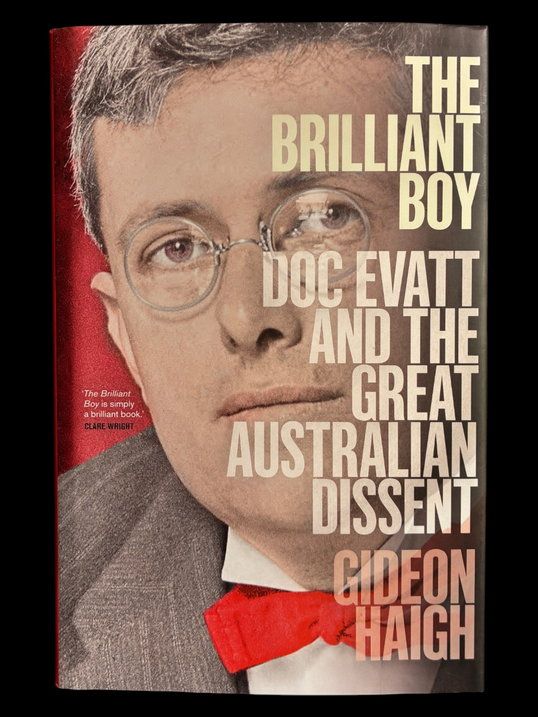
The Brilliant Boy: Doc Evatt and the Great Australian Dissent by Gideon Haigh
SKU 01159
AU$30.00
Price incl. GST (10%) AU$2.73
In stock: 1 available
1
Product Details
Book Type: SECONDHAND
ISBN: 9781760856113
Book Condition: Very Good
Dust Jacket Condition: Very Good
Author: Gideon Haigh
Edition: 1st Edition
Publisher: Scribner Australia
Place: Sydney NSW
Year: 2021
Format: Hardcover
Pages: 384 pages
Period: 20th Century
Book Description
Secondhand. Very good condition. Ex library copy with no external stickers. No stamps or stickers on inside page. Sticky tape on front endpage. RFID patch on inside back cover. Minor wear to book corners and edges. Dust jacket has light creasing at edges. Interior and binding are still very good.
In a quiet Sydney street in 1937, a seven-year-old immigrant boy drowned in a ditch that had filled with rain after being left unfenced by council workers. How the law should deal with the trauma of the family’s loss was one of the most complex and controversial cases to reach Australia’s High Court, where it seized the imagination of its youngest and cleverest member.
These days, ‘Doc’ Evatt is remembered mainly as the hapless and divisive opposition leader during the long ascendancy of his great rival, Sir Robert Menzies. Yet long before we spoke of ‘public intellectuals’, Evatt was one: a dashing advocate, an inspired jurist, an outspoken opinion maker, one of our first popular historians and the nation’s foremost champion of modern art.
Through Evatt’s innovative and empathic decision in Chester v the Council of Waverley Municipality, which argued for the law to acknowledge inner suffering as it did physical injury, Gideon Haigh rediscovers the most brilliant Australian of his day, a patriot with a vision of his country charting its path and being its own example – the same attitude he brought to being the only Australian president of the UN General Assembly, and instrumental in the foundation of Israel.
A feat of remarkable historical perception, deep research and masterful storytelling, The Brilliant Boy confirms Gideon Haigh as one of our finest non-fiction writers. It shows Australia in a rare light as a genuinely clever country prepared to contest big ideas and face the future confidently. (back cover)
The Brilliant Boy: Doc Evatt and the Great Australian Dissent by Gideon Haigh
You May Also Like
Display prices in:AUD