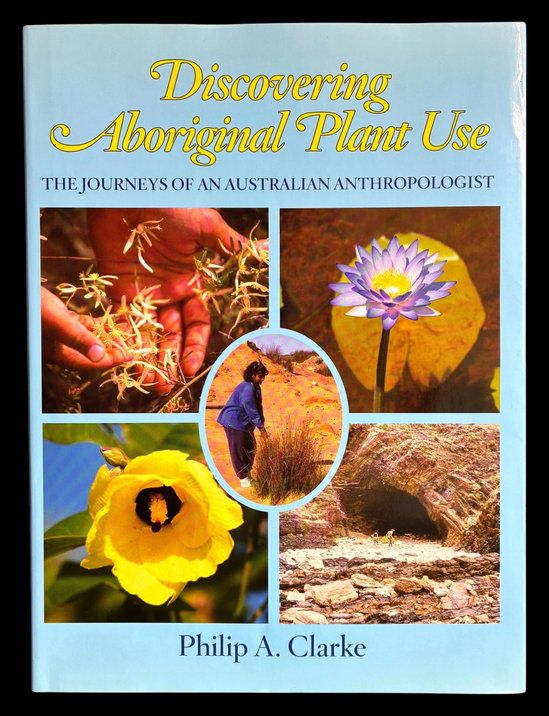
Discovering Aboriginal Plant Use: The Journeys of an Australian Anthropologist by Philip A Clarke
SKU 01537
AU$85.00
Price incl. GST (10%) AU$7.73
In stock: 1 available
1
Product Details
Book Type: SECONDHAND
ISBN: 9781925078220
Book Condition: Very Good
Dust Jacket Condition: Very Good
Author: Philip A Clarke
Edition: 1st Edition
Publisher: Rosenberg Publishing
Place: Dural NSW
Year: 2014
Format: Hardcover
Pages: 192 pages
Book Description
Secondhand. Very good condition. Minor wear to book corners and edges. Light sunning to top foredge. Dust jacket is now enclosed in protective covering. Interior and binding are also very good.
The career of a museum-based anthropologist is diverse, involving curating artifact collections, organizing exhibits, answering inquiries, and conducting fieldwork. Philip A Clarke started work at the South Australian Museum over 30 years ago, and, during that time, his role changed from museum assistant to collection manager, registrar, curator, and head of anthropology.
There are many ways to explore a culture other than your own, and Clarke chose ethnobotany as the 'window' through which to gain insights into Aboriginal Australia.
Ethnobotany is a diverse field that is concerned with investigating the relationships between human cultures and the flora. In the past, it was mainly used by scholars who studied the societies of hunter-gatherers and non-Western horticulturalists. Today, it is increasingly being used to document aspects of the lives of Indigenous peoples in a postcolonial world. Clarke argues that we can understand a people better if we know how they see and use plants.
In this book, Clarke dips into his field journals to provide a rich account of journeys - as both an anthropologist and an ethnobotanist - that span the temperate, arid, and tropical zones of Australia and neighbouring landmasses. Clarke describes the cultural and natural heritage of each region, examining the distinctiveness of the plant life used by Australia's Aboriginal people.
Aboriginal and Torres Strait Islander readers, please note that this book may contain descriptions and/or images of people who have passed away.
Discovering Aboriginal Plant Use: The Journeys of an Australian Anthropologist by Philip A Clarke
You May Also Like
Out of Stock
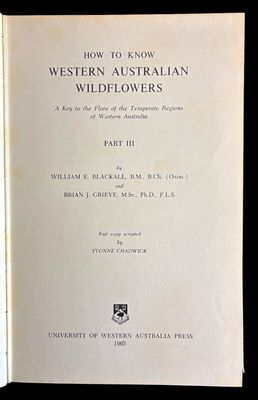
How to Know Western Australian Wildflowers: A Key to the Flora of the Temperate Regions of Western Australia: Part III by W E Blackall and B J Grieve
How to Know Western Australian Wildflowers: A Key to the Flora of the Temperate Regions of Western Australia: Part III by W E Blackall and B J Grieve
AU$25.00
Get notified when next available
Display prices in:AUD