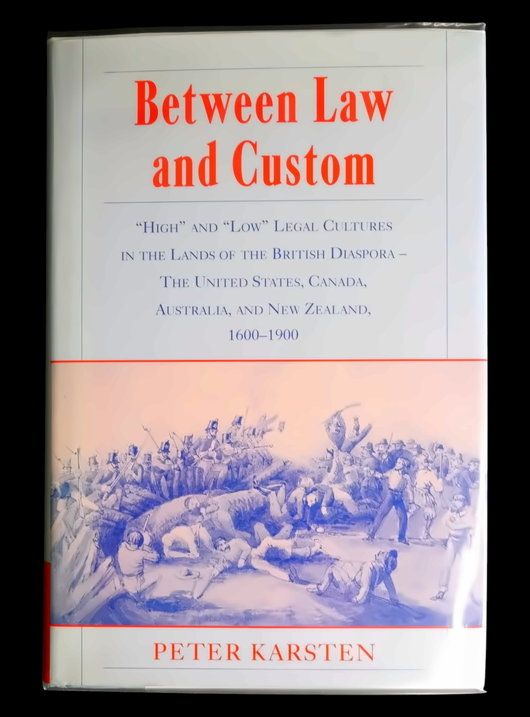
Between Law and Custom: High and Low Legal Cultures in the Lands of the British Diaspora: The United States, Canada, Australia, and New Zealand, 1600-1990 by Peter Karsten
SKU 01670
AU$75.00
Price incl. GST (10%) AU$6.82
In stock: 1 available
1
Product Details
Book Type: SECONDHAND
ISBN: 9780521792837
Book Condition: Very Good
Dust Jacket Condition: Very Good
Author: Peter Karsten
Edition: 1st Edition
Publisher: Cambridge University Press
Place: New York
Year: 2002
Format: Hardcover
Pages: 560 pages
Period: 17th, 18th and 19th Century
Book Description
Secondhand. Very good condition. Minor wear to book corners and edges. Dust jacket has light creasing at edges and spine. Dust jacket is now enclosed in protective covering. A review copy with documentation attached to front endpage. Signed by previous owner. Body text and binding are also excellent.
When British authorities established settler colonies in North America and the Antipodes (New Zealand, Australia, South Africa, Fiji) from the early seventeenth to the late nineteenth centuries, they introduced law through parliamentary statutes and Colonial Office oversight, and they dispatched governors and judges to the colonies. These jurists set aside some aspects of English Common Law to meet the special conditions of the settler societies, but the 'Responsible Governments' that were eventually created in the colonies and the British immigrants themselves set aside even more of the English law, exercising 'informal law' - popular norms - in its place.
Law and popular norms clashed over a range of issues, including access to land, the property rights of Aboriginal people, the taking of property for public purposes, master-servant relationships, and Crown/corporate liability for negligent maintenance and operation of roads, bridges, and railways.
Drawing on extensive archival and library sources in England, the United States, Canada, Australia and New Zealand, Karsten explores these collisions and arrives at a number of conclusions that will surprise. (book flap)
Between Law and Custom: High and Low Legal Cultures in the Lands of the British Diaspora: The United States, Canada, Australia, and New Zealand, 1600-1990 by Peter Karsten
You May Also Like
Out of Stock
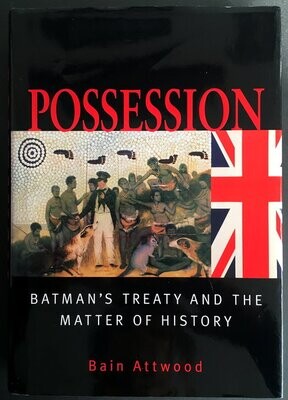
Possession: Batman's Treaty and the Matter of History by Bain Attwood
Possession: Batman's Treaty and the Matter of History by Bain Attwood
AU$48.00
Get notified when next available
Display prices in:AUD