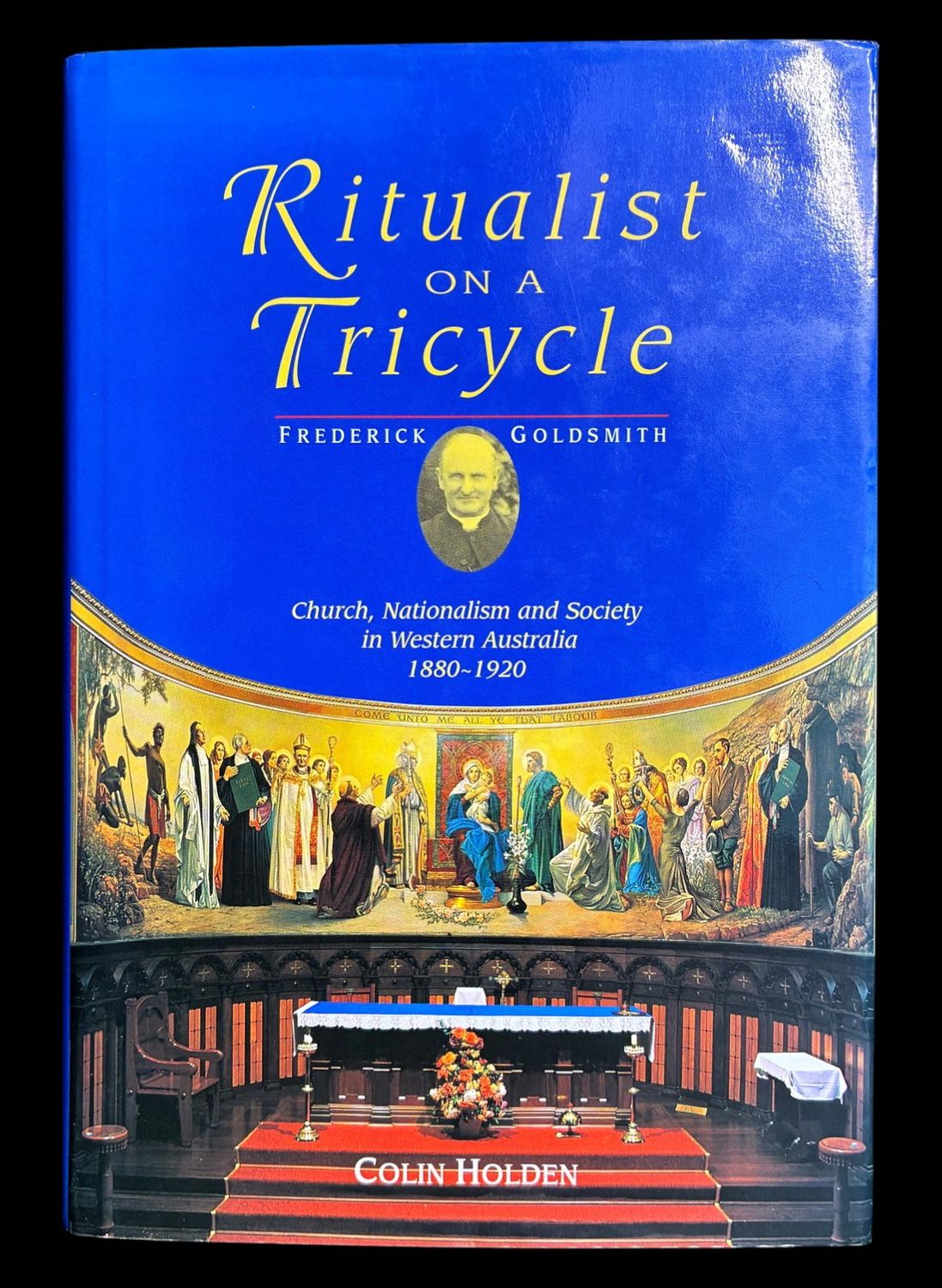
Ritualist on a Tricycle: Frederick Goldsmith: Church, Nationalism and Society in Western Australia 1880-1920 by Colin Holden
SKU 00485
AU$35.00
Out of Stock
Price incl. GST (10%) AU$3.18
Out of Stock
Product Details
Book Type: SECONDHAND
ISBN: 9781875560981
Book Condition: Very Good
Dust Jacket Condition: Very Good
Author: Colin Holden
Edition: 1st Edition
Publisher: University of Western Australia Press
Place: Nedlands WA
Year: 1997
Format: Hardcover
Pages: 412 pages
Period: 19th and 20th Century
Book Description
Secondhand. Very good condition. Minor wear to book corners and edges. Previous owner has inscribed front blank endpage. Dust jacket has light creasing at edges and spine, and is enclosed in a glossy protective cover. Body text and binding are still very good.
'Revolutionary' was the response of one of his contemporaries to Frederick Goldsmith, the first Anglican Bishop of Bunbury (1904-17) and the state's leading Anglo-Catholic, who rode an iron frame tricycle for exercise to combat his asthma.
Colin Holden's study examines city and rural Anglicanism from the goldrush to the end of World War 1, changing devotional life and church politics in the context of British imperial values and growing nationalism and provides an insight into the paradox of a conservative individual who was a key figure in a movement within Anglicanism that many considered radical or subservient.
In an effort to avoid the Anglican church becoming 'exotic and foreign to future generations', Goldsmith urged the abandonment of the title 'Church of England' in Australia in 1899 and was distinguished as a champion of Australian nationalism, despite his English origins.
His foundation of a bush brotherhood to provide ministry to the isolated people of the bush and to train his clergy, which functioned like a monastic community, also combined the conservative and the radical.
His influence in rural Western Australia was felt beyond his retirement through two former bush brothers, Edward Elsey and John Frewer, who became bishops of Kalgoorlie and the North West; and his successors in Bunbury continued to come from the Catholic wing of Anglicanism.
Ritualist on a Tricycle: Frederick Goldsmith: Church, Nationalism and Society in Western Australia 1880-1920 by Colin Holden
You May Also Like
Display prices in:AUD