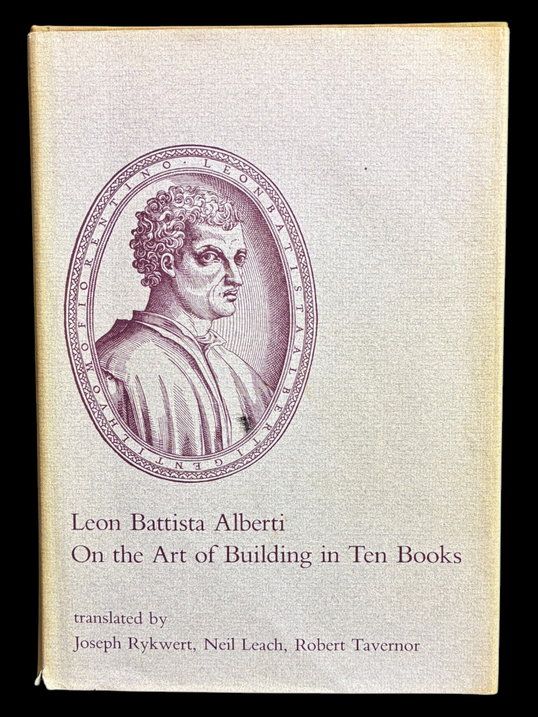
On the Art of Building in Ten Books by Leon Battista Alberti and translated by Joseph Rykwert, Neil Leach, and Robert Tavernor
SKU 01068
AU$210.00
Price incl. GST (10%) AU$19.09
In stock: 1 available
1
Product Details
Book Type: SECONDHAND
ISBN: 0262010992
Book Condition: Good
Dust Jacket Condition: Good
Author: Leon Batista Alberti
Edition: 1st Edition
Publisher: MIT Press
Place: Cambridge MA
Year: 1988
Format: Hardcover
Pages: 442 pages
Book Description
Secondhand. Good condition. Wear to book corners and edges. Foxing to top and right foredges. Marks on tail foredge. Dust jacket is worn with sunning to spine. Front book flap is price-cut. Dust jacket is now in a protective cover.
Leon Battista Alberti (composed 1443–1452, published posthumously in 1485) is the first modern treatise on architectural theory. This landmark English translation by Joseph Rykwert, Neil Leach, and Robert Tavernor is celebrated for updating the text from its original classical Latin.
Alberti structured his masterpiece into ten books, mirroring the classical format of the ancient Roman architect Vitruvius. He organised his theory around three overarching architectural virtues: Solidity (firmitas), Use (utilitas), and Grace/Beauty (venustas).
Rykwert's substantial introduction discusses Alberti's life and career - as papal functionary, writer on a wide variety of topics, and architect and discusses the De Re Aedificatoria itself: its relation to the De Architectura of Vitruvius, its influence on contemporary and later architectural theory and practice, and its bibliographic history. The apparatus also includes an index and a glossary of terms.
The translators were fortunate to have the help of eminent Alberti scholar Hans-Karl Lücke of the University of Toronto. Alberti set out to replace Vitruvius's authority, which had been undisputed for over a thousand years. In a Latin which was both more elegant and more precise than that of his ancient predecessor, he succeeded in framing a coherent account of the fragmented knowledge of antique architecture as it had survived through the dark and middle ages. His was the one book which established architecture as an intellectual and professional discipline rather than a craft and gave it a proper theoretical context; by showing how the great examples of ruined antiquity could be emulated in practice, it provided a theoretical basis for the architecture of the Renaissance. Alberti organises the architect's work according to solidity, use, and grace.
The ten books begin with a book of definitions; there follow two books devoted to materials and constructional methods; books four and five discuss the uses of the parts of the building and the different building types. The bulk of the second part, books six through nine, deal with grace: the problems of designing sacred buildings, the problems of beauty and ornament, of proportions. Book ten takes up problems of restoration, water supply, and minor adjuncts to building. (publisher blub)
Book one: Lineaments
Book two: Materials
Book three: Construction
Book Four: Public works
Book five: Works of individuals
Book six: Ornament
Book seven: Ornament to sacred buildings
Book eight: Ornament to public secular buildings
Book nine: Ornament to private buildings
Book ten: Restoration of buildings.
Alberti set out to replace Vitruvius' authority, which had been undisputed for over a thousand years, and to frame a coherent account of the fragmented knowledge of ancient architecture as it had survived through the dark and middle ages. His is the one book that established architecture as an intellectual and professional discipline rather than a craft and gave it a proper theoretical context. It provided a theoretical basis for Renaissance architecture.
On the Art of Building in Ten Books by Leon Battista Alberti and translated by Joseph Rykwert, Neil Leach, and Robert Tavernor
Display prices in:AUD